Most support teams review between 1% and 3% of their customer conversations. Based on that small sample, they make decisions about coaching, training, customer experience, and product strategy. For decades, this was simply how quality control worked.
AI changes that completely. For the first time, support leaders can see, analyze, and act on every single conversation their team has with a customer.
This article walks through how to build that system: from translating business goals into AI evaluation logic, to designing the right criteria and attributes, to redefining the role of the human inside the process.
Why traditional QA stops working
Most support teams build quality control the same way. They define a set of scorecards. They assign someone to review them, usually a QA specialist or a senior agent. They set a target: maybe 30 to 50 chats per agent per period. They collect everything into reports, and deliver feedback in one-on-one meetings.
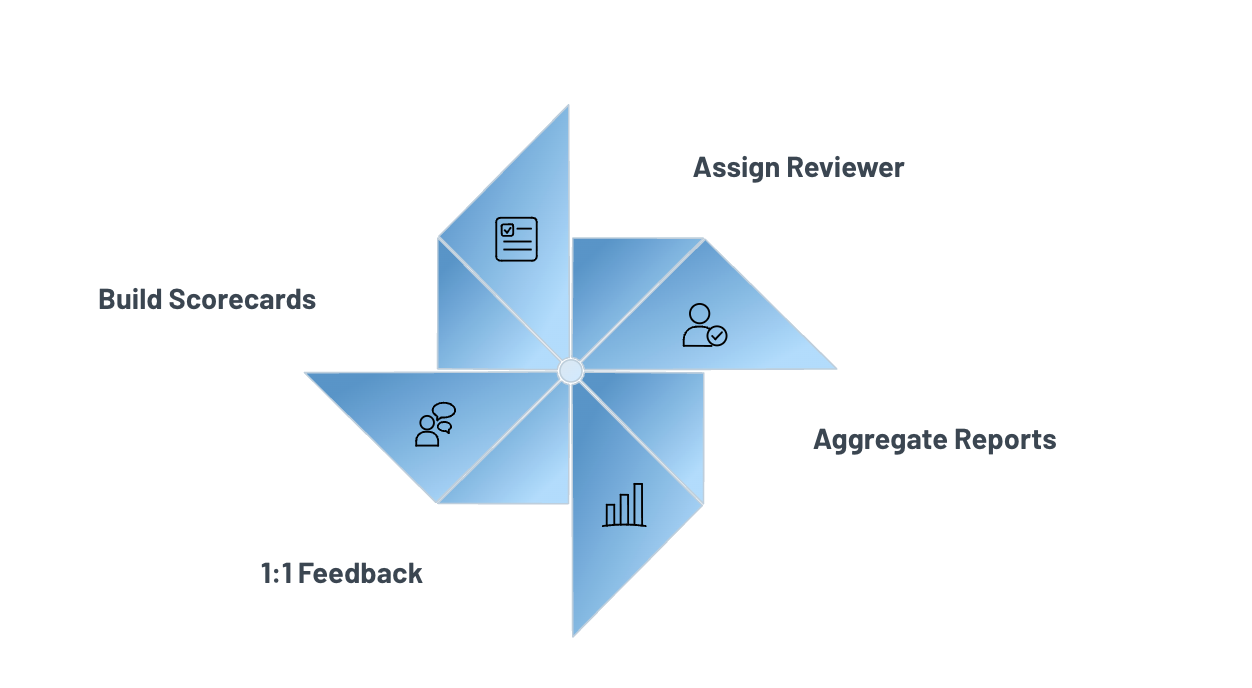
This approach can work until the team grows.
A fast-growing support team is the moment traditional QA begins to break. When headcount doubles, when conversation volume rises sharply, when the team is spread across multiple channels and time zones, the standard approach can't keep up. Four problems emerge:
It doesn't scale. To review more conversations, you have to hire more reviewers. Quality control becomes expensive and slow.
The sample is too small. A team reviewing 3–5% of conversations is making decisions about the other 95% based on extrapolation.
Feedback comes too late. By the time an agent hears about a conversation, it's often two or three weeks old. By then, they've already repeated the same mistake dozens of times.
Insight gets lost. Support conversations contain far more than agent performance data. They contain product feedback, customer frustration, churn risk, and competitive intelligence. In a manual QA process, most of this is missed entirely or surfaced too slowly to act on.
What changes with AI
The shift is simple: AI can read and evaluate every conversation, in every channel, in real time.
That single change has four consequences:
- Sampling disappears. You no longer pick 3% of tickets to review — you review them all.
- Insight stops hiding. Patterns across thousands of conversations become visible in minutes.
- Scale stops being the enemy. Volume can grow without adding reviewers.
- Feedback gets fast. Coaching notes can land the same day, sometimes the same hour.
But there's a deeper shift that often gets missed. AI changes what's possible to measure.
Old metrics like CSAT and First Response Time become more honest. CSAT is no longer just a sample of self-selected customers in a particular mood; AI can read every conversation and assess real satisfaction between the lines. First Response Time is no longer the speed of "I'm looking into this" — it's the speed of the answer that actually moved the customer forward.
And entirely new metrics emerge. Coverage — what percentage of conversations were actually evaluated this month — becomes a metric worth tracking on its own. Criteria-level scoring across the team replaces single-agent scores. Business signals from conversations — churn frequency, feature requests, pricing objections — become measurable, week over week.
Four questions to ask before building
At Qualiteam, we work with support teams across many industries to build their quality control systems. One approach consistently works as a starting point: before defining any criteria or selecting any platform, answer four questions.
1. What is the role of support in your business model?
Is the team mainly helping users solve issues? Driving adoption? Reducing risk? Supporting sales? In SaaS, for example, support typically handles product questions and technical issues. But those same conversations also surface recurring needs, feature requests, friction points, and emerging trends — making support a powerful contributor to product growth and strategic development.
2. Which conversations have the highest business impact?
Cancellations, payment problems, onboarding failures, and compliance-sensitive cases are not equivalent to "where can I find the export button," and the AI shouldn't treat them as if they were. If customer retention drives the bottom line, the AI can monitor churn signals, evaluate how agents respond, and track which retention approaches actually work. If revenue growth matters — common in travel, insurance, or e-commerce — the AI can surface upsell and cross-sell moments and evaluate whether the team is acting on them.
3. What does a "good conversation" actually look like for your company?
Fast? Empathetic? Accurate? Risk-safe? Premium? Two companies in the same industry can answer this completely differently and both can be right. Brand alignment matters in every conversation, whether the company is a luxury brand where support has to match VIP service, a technical product where support has to be fast and clear, or a B2B partner where every conversation shapes a long-term commercial relationship.
4. Which mistakes are expensive for the business?
Wrong information, missed escalations, policy violations — whatever lands on this list becomes a red flag the AI watches for in every conversation. In industries like online brokerage, fintech, or trading platforms, managing legal and compliance risk is critical. The AI can evaluate how complaints, conflicts, and escalations are handled, and whether any regulatory boundaries were crossed.
The honest answers to these four questions form the foundation of the entire system.
The Quality Loop Framework
The system itself is a cycle with five connected stages.
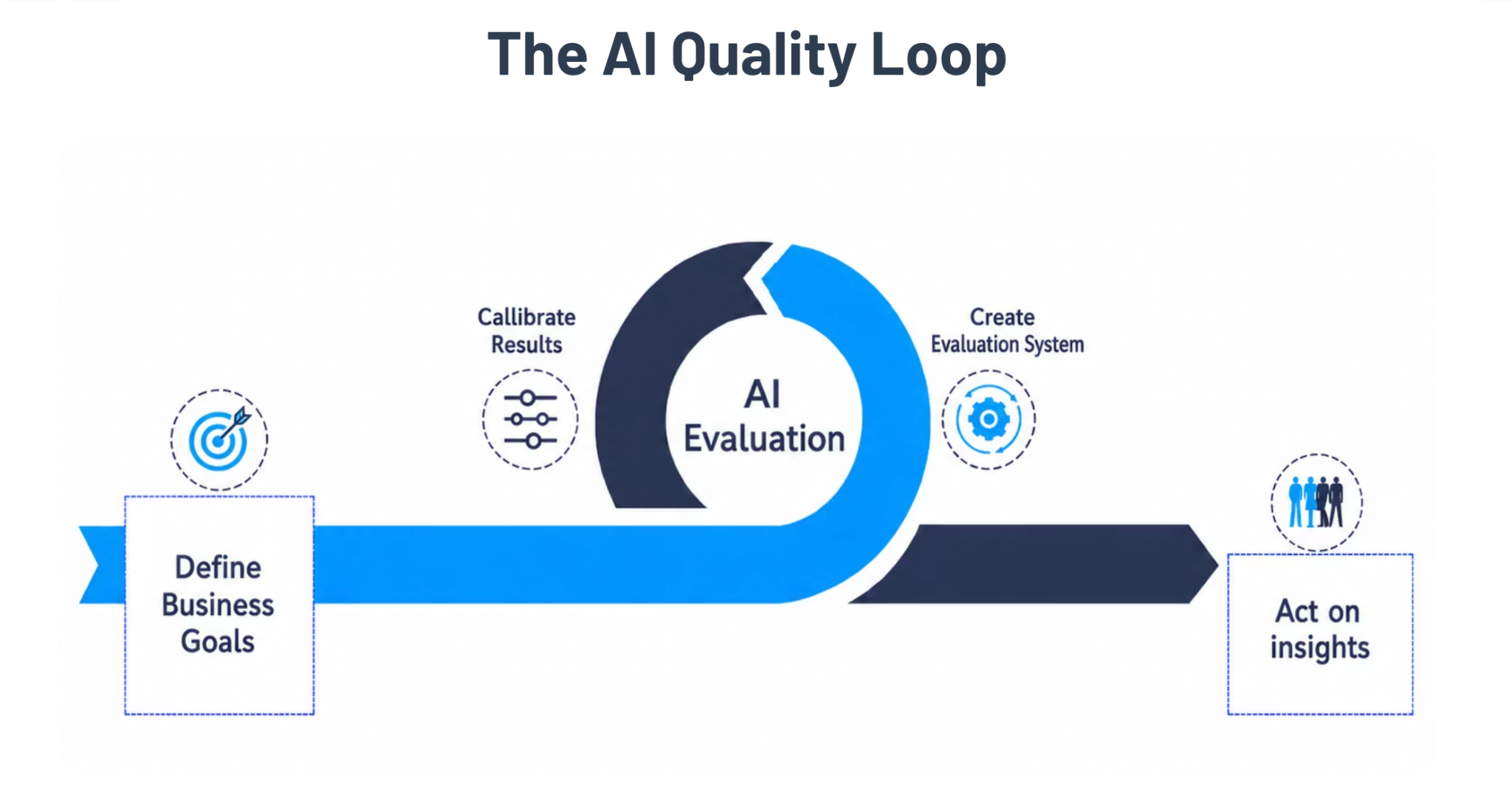
Define business goals. This is what the four questions answer.
Create an Evaluation system. Each business goal translates into something the AI can look for in a conversation.
Evaluate with AI. The AI reads every conversation, every channel, every agent, and applies the criteria defined by the business.
Calibrate with humans. Especially early on, humans review the AI's evaluations, correct them where they're off, and feed back context, nuance, and edge cases. The AI gets sharper because humans teach it.
Act on the insights. This is where most QA programs quietly die. They produce beautiful reports, and nothing changes. The output of this loop must always answer one question: what is the business going to do about it?
Each stage feeds into the next, and the cycle continues — the system gets better as the business evolves.
Criteria and attributes
The single most important practical concept inside this framework is the distinction between criteria and attributes.
Traditionally, quality is measured through scorecards. But for AI to do this work properly — to identify the right type of information and return the results that are actually useful — it helps to split the work into two distinct directions, because each one works differently.
Criteria evaluate the work of the team and each agent. They assess the quality of service customers receive. A criterion might evaluate:
- tone and warmth
- spotting an upsell opportunity
- proper diagnosis and escalation
- handling of sensitive data
- clear resolution or a defined next step
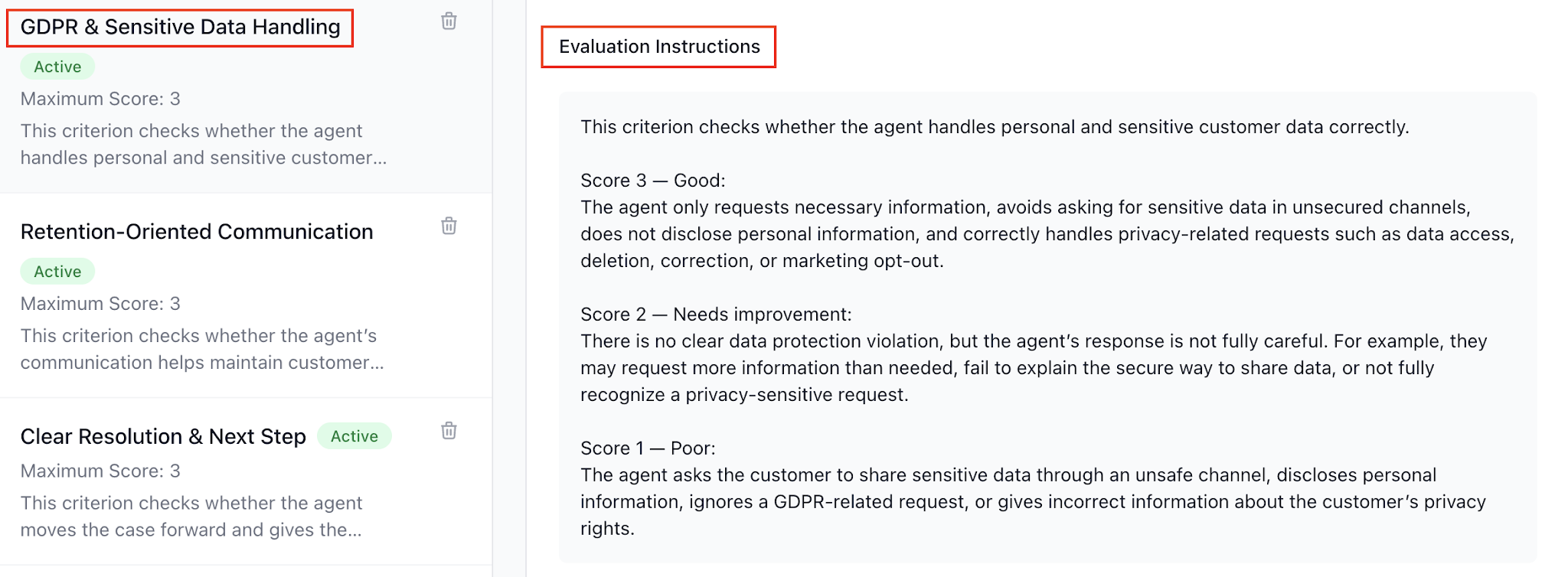
For each criterion, the AI is given an instruction: what to evaluate, what good looks like, what bad looks like. The more detail provided, the more accurate the evaluation becomes. The result is a score for every conversation and a score for every agent — making it possible to see exactly where the team is strong and where it needs more training.
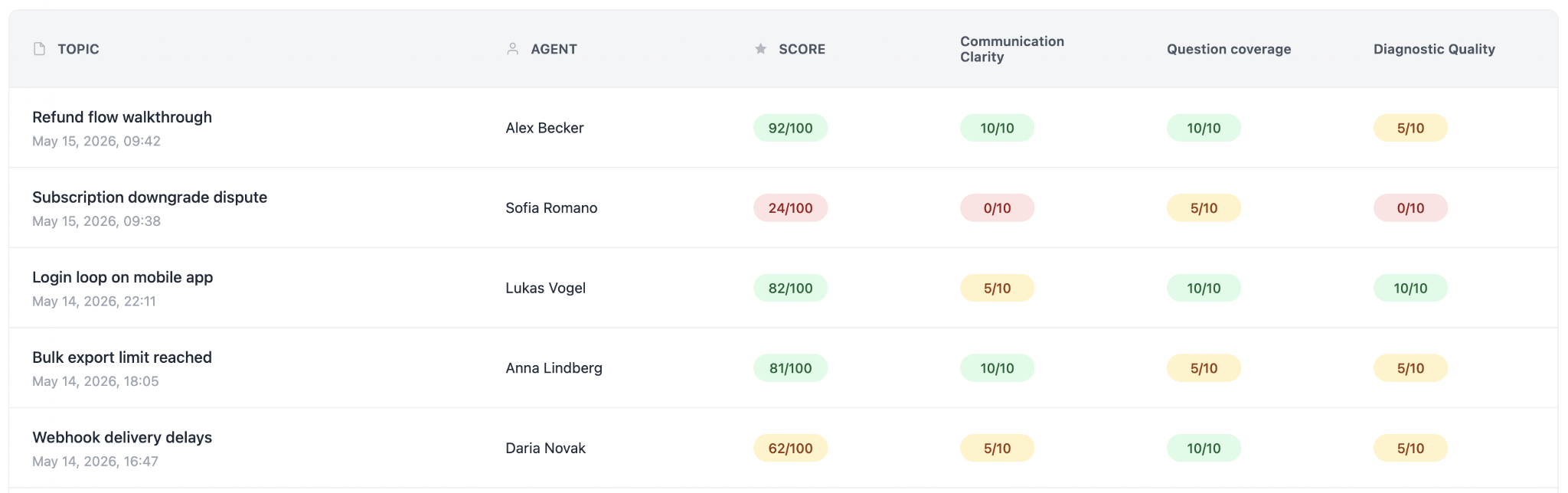
Behind every score, the AI provides a detailed explanation — what worked well in the conversation, what could have been done differently, and concrete recommendations for improvement. Rather than handing back a number with no context, the AI shows its reasoning in plain language. For example: that a customer mentioned billing twice but only the first point was addressed, and that acknowledging both before solving would have made the response stronger. Every evaluation becomes a coaching moment — not just a score, but an explanation the agent can learn from and the manager can act on.
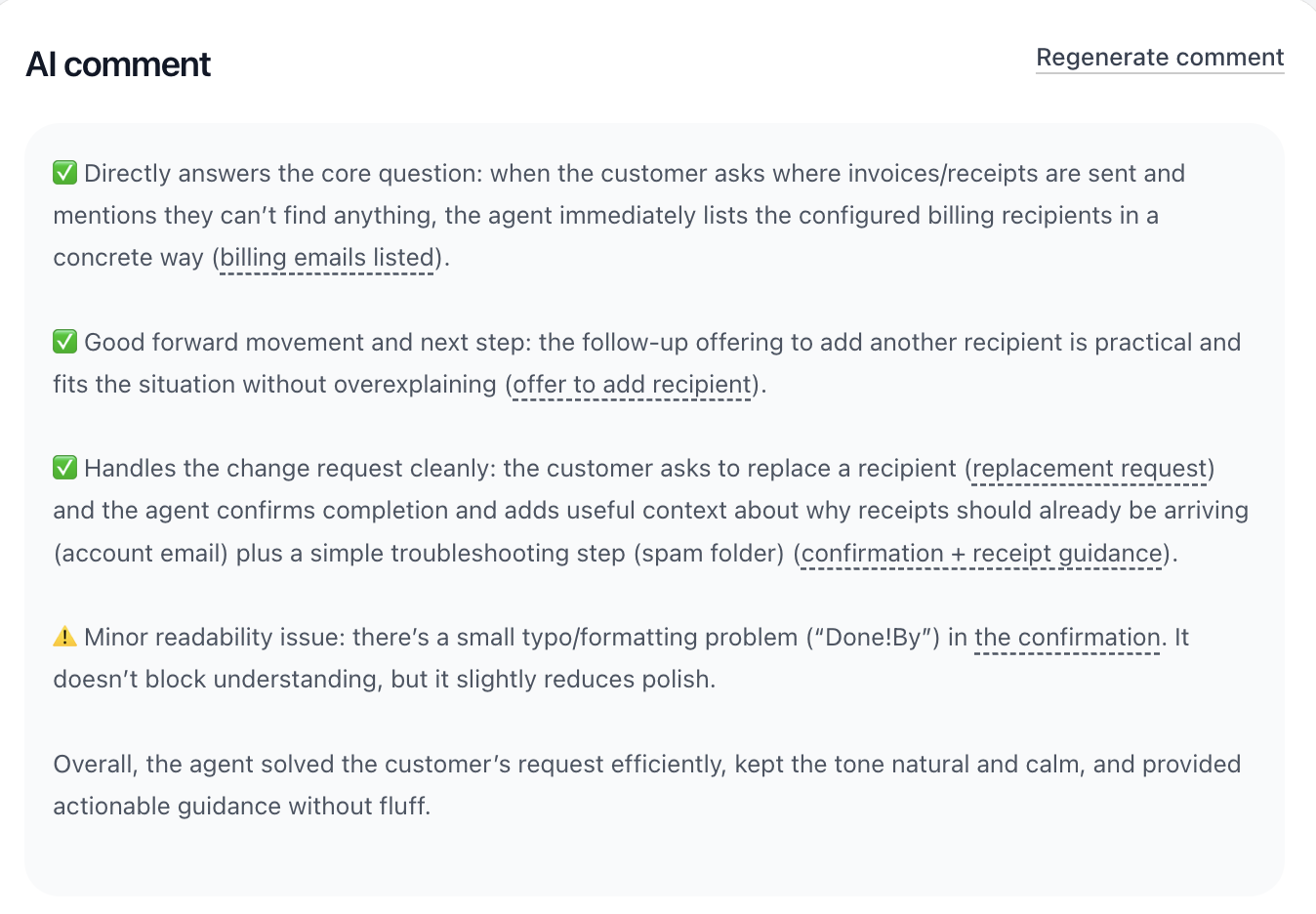
Attributes evaluate the conversation itself. They categorize, extract, and tag the information that lives inside the dialog. Useful attributes answer questions like:
- Are there churn signals in this conversation?
- What product feedback are customers giving us this week?
- What are customers complaining about most?
- Which competitors are coming up in our conversations?
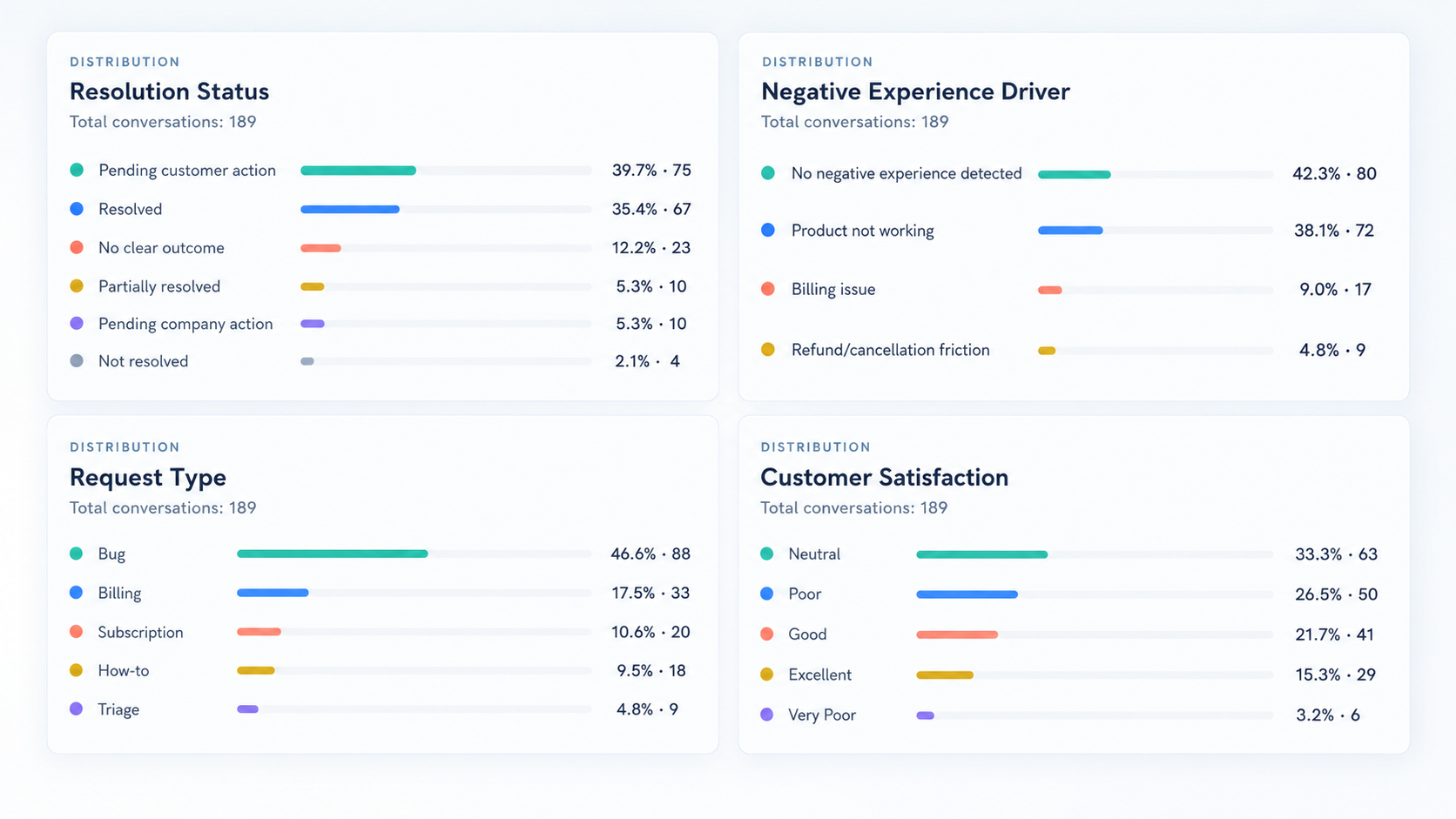
Taken together, criteria and attributes become the most honest, ground-truth dataset a company has about what's actually happening in its conversations with customers — the data that shapes what gets fixed, what gets built next, and where the business grows.
Real-time alerts: closing the time gap
Using AI to analyze customer conversations also closes the gap on time.
Hours are no longer spent reading through chats. Feedback can be delivered to the team in real time. And critical situations can be addressed in the moment they happen, not weeks later.
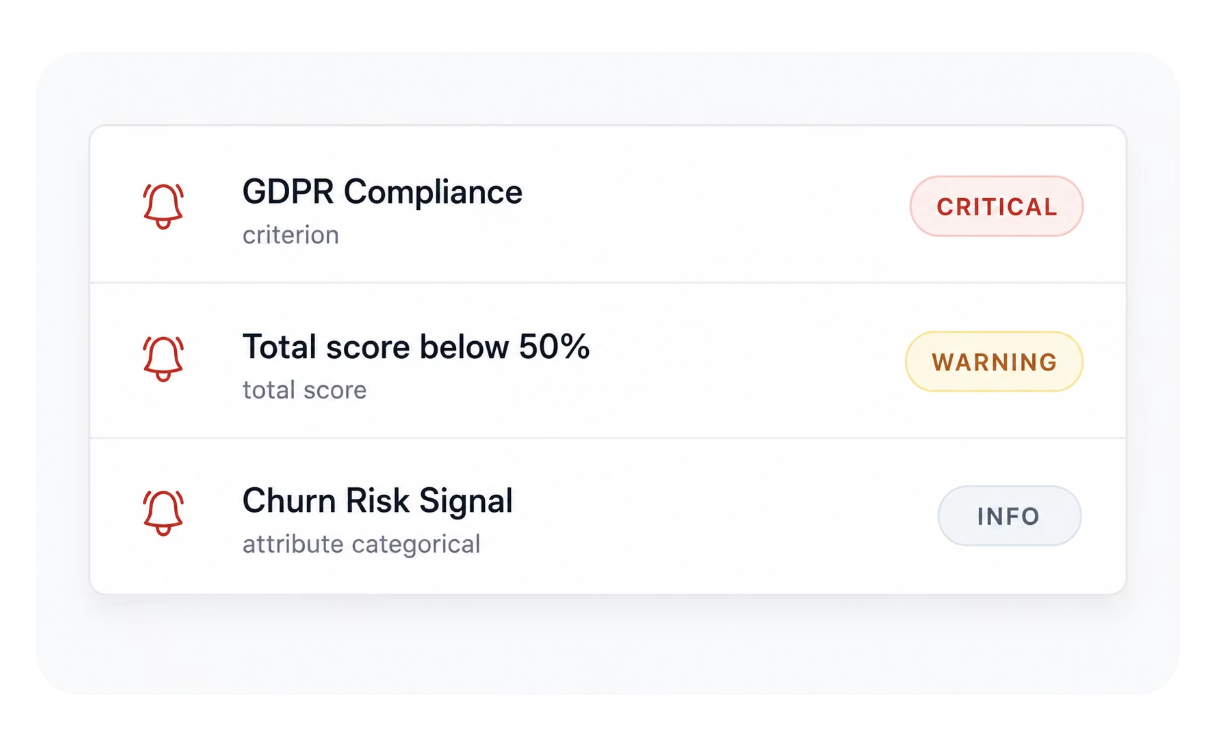
This is typically implemented through a system of alerts. If a customer complaint arrives that could turn into a legal issue, a notification can reach the right person within ten minutes — not when a lawsuit lands on a desk weeks later.
The deeper shift is that AI keeps the company informed of what really matters in customer conversations, and gives the team the chance to address problems in the moment — before they have time to grow into real problems.
The role of the human in an AI-powered system
A common question support leaders ask: if AI is now reading every conversation and scoring every agent, what is left for the human QA manager to do?
The honest answer is: The role becomes more strategic.
AI does what AI is good at: reading, scoring, finding patterns at scale. The boring work. The work no human team could ever match. But every decision that makes the system useful still belongs to a human.
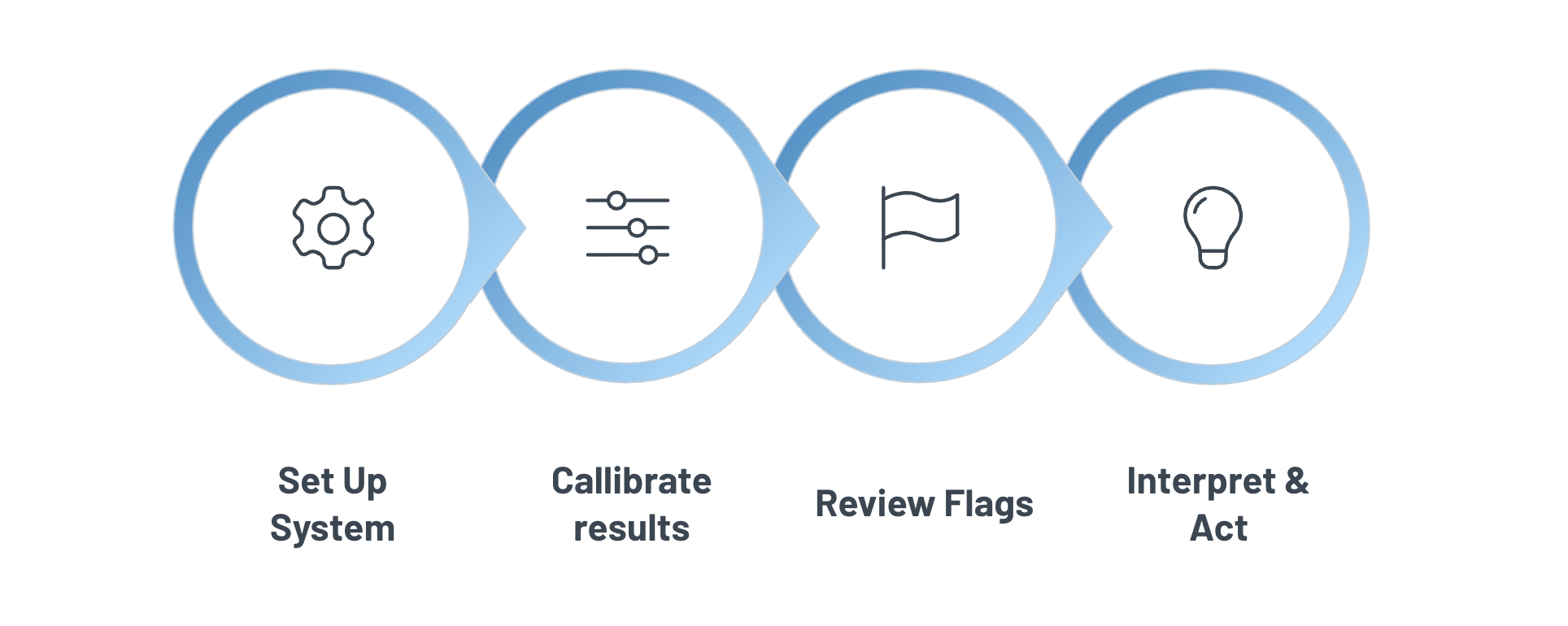
Setting up the system. The criteria, the attributes, the priorities — those decisions come from the business, not from the AI.
Teaching the AI. Early on, the AI will be wrong sometimes. A human corrects it, gives it context, refines the criteria where they're ambiguous. The AI gets sharper because a human teaches it.
Acting on what the system surfaces. AI shows what is happening; a human decides what to do about it. Coaching, process changes, product feedback — that is human work.
Updating the system. Companies don't stand still. Products ship new features. Strategies shift. The Quality Control Manager owns that evolution and keeps the system in step with the business.
In an AI-powered system, the QC Manager stops being the person who reads a small sample of tickets. They become the architect of how the company sees its customers.
AI as a coaching tool for the team
Any process implemented in a team should serve the team’s interests and help it to carry out its work more effectively.The same principle applies to AI evaluation.
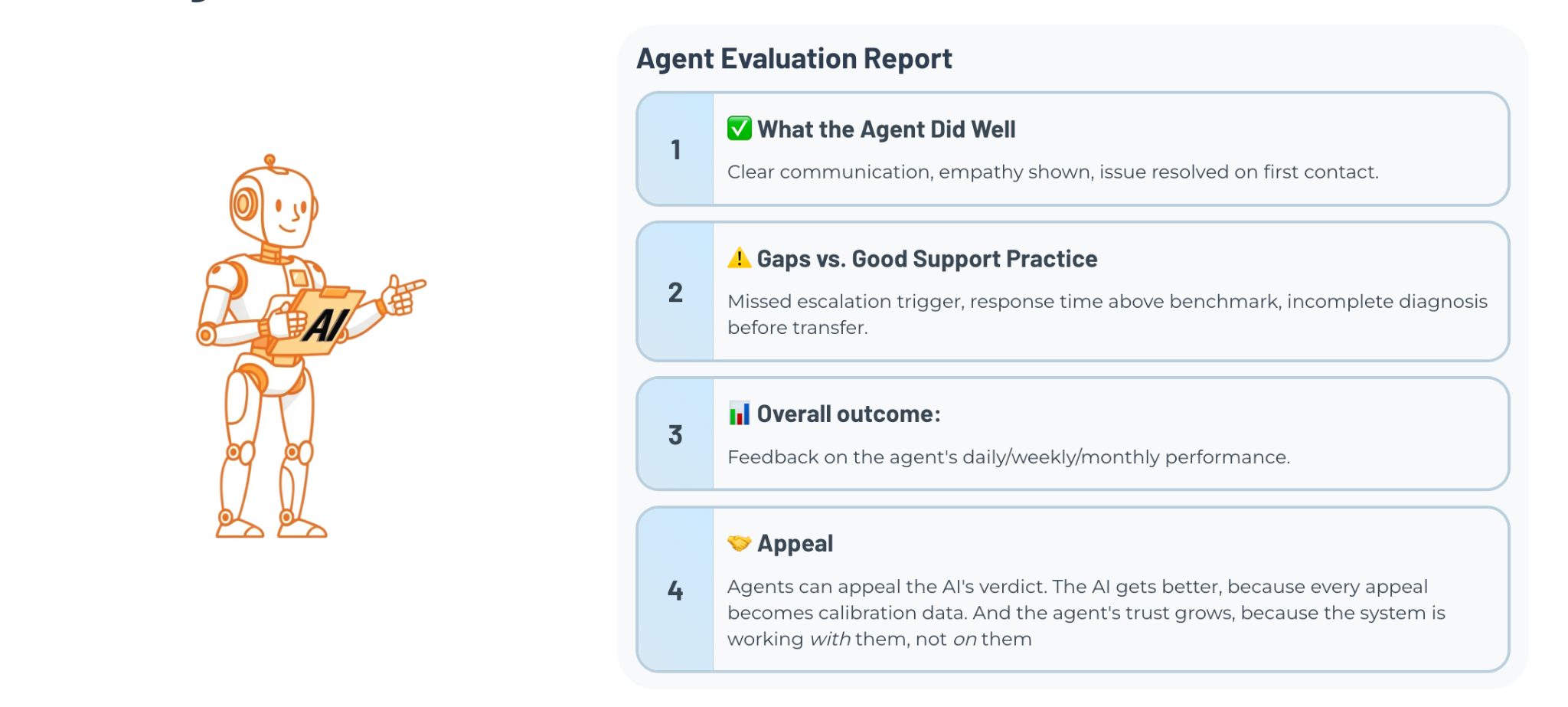
When designed well, an AI quality system becomes one of the most powerful coaching tools an agent has ever had. It can tell each agent three things:
- what they're doing well
- where they have room to grow
- an overall picture of their performance
And agents don't have to wait for a monthly one-on-one to hear any of it. They can track their own results on a daily basis.
The system works best when agents can push back. When the AI scores something they disagree with — and it will happen — they need an easy way to appeal, to start a conversation rather than receive a verdict. Two things happen when the system is built this way: the AI gets better, because every appeal becomes calibration data; and agents trust the system, because they know it's working with them, not on them.
Looking forward
AI is reshaping every industry. The real question is where it actually brings value.
AI is excellent at reading and analysing large volumes of text. And in the customer support department, every team has access to the most extensive set of text data a company could possibly create—every conversation ever held with customers.
AI gives support leaders something they never had before: continuous visibility across every customer conversation. And that visibility is what turns support from a team that answers questions into a team that actively grows the business.